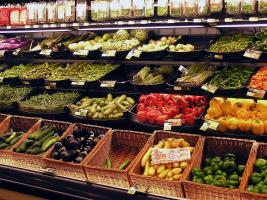
While the weather outside might be frightful, it only makes a winter farmers’ market all the more delightful. Farmers’ markets, traditionally held in more temperate months, are known for their fresh, delicious produce, baked goods and crafts. The festivity and camaraderie between farmers, crafters, artisans and their customers actually may draw more people to a farmers’ market than the fresh food does. But cold months tend to put the kibosh on such markets in areas where the thermometer dips below freezing. There is hope though.
Showing posts with label Christina. Show all posts
Thursday, November 5, 2009
Winter Farmers' Market Offers Fresh, Local Food All Year
While the weather outside might be frightful, it only makes a winter farmers’ market all the more delightful. Farmers’ markets, traditionally held in more temperate months, are known for their fresh, delicious produce, baked goods and crafts. The festivity and camaraderie between farmers, crafters, artisans and their customers actually may draw more people to a farmers’ market than the fresh food does. But cold months tend to put the kibosh on such markets in areas where the thermometer dips below freezing. There is hope though.
Tuesday, October 20, 2009
Availability of fresh food, exercise linked to healthy living
St. Paul, Minn. — Efforts to bring a supermarket into an underserved St. Paul neighborhood shine a light on a often overlooked fact: where we live has a direct effect on how we eat, exercise and ultimately, how healthy we are.
At the corner of Maryland Avenue and Clarence Street, just south of Lake Phalen in St. Paul, there's a Cub Foods store. A year ago, there was no supermarket here. There was a bar, an express lube, and a car wash.
Back then, people in this neighborhood had to travel at least a mile to get to a supermarket. Now, the grocery store is filled with fresh fruits and vegetables, ethnic foods of all kinds, and lots of choices.
Monday, October 19, 2009
Food labeling confuses many people, critics say
At first it may seem only right for Dean Foods, the nation's largest organic dairy producer, to roll out a line of yogurts and milk marketed as "natural."
But Dean's announcement in the last week of June alarmed advocates of organic food, who say the burgeoning market for less-expensive "natural" foods reaps billions from consumers while guaranteeing little or nothing in exchange. Certified organic food products are regulated by the U.S. Department of Agriculture and produced by farmers and manufacturers under a strict set of rules. But the agency defines the term "natural" only for meat and poultry. In the rest of the food industry, the meaning is largely up to the producer.
Fresh, Fresh, Exciting: Near East Side Dwellers Get Boxes of Green Goodness
by Melinda Clynes-modeldmedia.com
Detroit's Near East Side boasts an overabundance of gas stations and liquor-lotto marts, where residents are more apt to find rows of Colt 45 and Fritos, rather than bundles of fresh greens or bushels of apples. These neighborhoods are in general a prime example of a community in the city without easy access to quality grocery stores and fresh produce.
That's not the case this summer, however.
Kale, zucchini, tomatoes and cucumbers are just some of the veggies packing a nutritional punch this summer for Near East Side residents as part of a new initiative called Fresh Food Share -- a program that brings boxes of fresh produce to locals who contend with the absence of nearby grocery stores. At the same time, the program is building a stronger sense of community within a racially, ethnically and economically diverse area of the city.
Greenbacks for greens...
Fresh Food from City Soil
By Winstina S. Hughes
Brick City FarmsWinstina S. Hughes Lorraine Gibbons, of Maplewood, and John Taylor, who are partners in a sustainable farming business in Newark.
It’s raining softly outside the hybrid. We’re parked at a once-empty lot at the corner of Spruce Street and Washington Street near Lincoln Park in Newark, home to Brick City Urban Farms. John Taylor is explaining how seamlessly the pieces fell into place for the business venture on the site.
It started with an idea and then a call to Lorraine Gibbons, a colleague who lives in Maplewood and designs edible gardens as part of school curriculums. She also created the edible gardens for both Seth Boyden Elementary in Maplewood and the garden for the township’s historical house, Durand Hedden.
“I said, ‘Lorraine, I’m impressed with your work designing edible gardens at schools. We want to start an urban farm in the city,’ ” Mr. Taylor said.
Farm Fresh Food in School Lunches
The Live Healthy Nevada County Food and Nutrition Action Committee is trying its best to introduce healthy, fresh foods to area schools. “We are very keen to get programs implemented throughout Nevada County,” said Aimee Retzler.
Live Healthy’s pilot program is with Hennessy Elementary in Grass Valley. By partnering with Riverhill Farm, the program is finding success with nutrition education, bringing more fruits and vegetables into the diet, and bringing the farm to school. Recently the summer school class took a fieldtrip to Riverhill. “It’s fantastic hands-on learning,” said Retzler. Children went from plot to plot, learning about how food is planted and grows. As they learned, they harvested, and at the end of the tour, they made a huge salad. So excited about the food they had helped pick, the class chose to eat it instead of the school lunches that had been packed.
Tuesday, October 6, 2009
Flat world, fat world: Report from the Healthy Foods, Healthy Lives Symposium, part 1
On September 21, 2009 in Minneapolis, a crowd of 300 people representing more than 30 disciplines gathered for a symposium hosted by the Healthy Foods, Healthy Lives Institute to discuss critical issues in research and policy related to food and health.
hfhl-2They also ate very, very well. Most conferences feature food, why make a big deal of this one? Because those who produced the ham-and-cheese sandwiches with fig chutney, the quinoa salad, and the lemon-ginger cookies, are local to the Twin Cities, farm without using raw manure (you’ll learn more about this in part III), practice ethical animal husbandry, steward the land, and feed their local communities, creating economic and health benefits. In other words, these healthy foods nourish healthy lives. Catered by Birchwood Café, follow them on Twitter, producers included: Hoch Orchards, Whole Grain Milling, Dragsmith Farms, Wild Acres Farms, Fischer Farms, Featherstone Farm, Hope Butter, Riverbend Farm, Peace Coffee, Birchwood Herb Garden (Facebook page), Garden Farme, and Common Roots Café.
Three themes emerged at the conference:
• As our world shrinks, our waists grow
• The nutritional debate over processed food
• What’s in the meat you eat and the water you drink
hfhl-2They also ate very, very well. Most conferences feature food, why make a big deal of this one? Because those who produced the ham-and-cheese sandwiches with fig chutney, the quinoa salad, and the lemon-ginger cookies, are local to the Twin Cities, farm without using raw manure (you’ll learn more about this in part III), practice ethical animal husbandry, steward the land, and feed their local communities, creating economic and health benefits. In other words, these healthy foods nourish healthy lives. Catered by Birchwood Café, follow them on Twitter, producers included: Hoch Orchards, Whole Grain Milling, Dragsmith Farms, Wild Acres Farms, Fischer Farms, Featherstone Farm, Hope Butter, Riverbend Farm, Peace Coffee, Birchwood Herb Garden (Facebook page), Garden Farme, and Common Roots Café.
Three themes emerged at the conference:
• As our world shrinks, our waists grow
• The nutritional debate over processed food
• What’s in the meat you eat and the water you drink
Labels:
Christina,
nurtitional debate,
processed food
Monday, September 21, 2009
New Sugar Guidelines: Not-So-Sweet News for Your Heart
In a shocking surprise to most of us dietitians, the American Heart Association (AHA) stood up to the food industry earlier this month and essentially made eating and drinking a lot of items in the supermarket off-limits.
Why? Because sugar has just earned a spot on the AHA’s black list, joining saturated fat, cholesterol, and sodium as negative nutrients that need to be limited for your heart’s sake.
________________________________________
Note the use of the "nutrient" language in the above excerpt, which Pollan describes in the chapter on nutritionism.
Why? Because sugar has just earned a spot on the AHA’s black list, joining saturated fat, cholesterol, and sodium as negative nutrients that need to be limited for your heart’s sake.
________________________________________
Note the use of the "nutrient" language in the above excerpt, which Pollan describes in the chapter on nutritionism.
Labels:
American Heart Association,
Christina,
Foods
Subscribe to:
Posts (Atom)